
Hi! It’s me, Sensei!
A new life and a new job in Japan—it’s exciting, isn’t it?
I’m sure you studied many words at a Japanese language school or from a textbook (Kyokasho / 教科書). However, at a Japanese company (Genba / 現場), there are very important rules that are not written in textbooks.
Your boss and seniors look at your “Attitude (Taido / 態度)” more than your Japanese language ability (Nihongo Noryoku / 日本語能力).
This time, I will introduce 6 NG behaviors that make Japanese people feel “disappointed (Gakkari / ガッカリ)” even if you have no malice (Akui / 悪意), along with their solutions (Kaiketsu-saku / 解決策).
- ① Not as “Energetic” as during the interview!
- ② Don’t step on the “Doma” with socks when taking off shoes!
- ③ Forgetting to say “Thank you” when receiving a uniform
- ④ Keeping “Hats and Sunglasses” on inside buildings
- ⑤ Using a “Smartphone” or “Leaning against the wall” while waiting
- ⑥ Not taking out a “Memo” when listening to instructions
- Summary: “Charm” is more important than technology!
① Not as “Energetic” as during the interview!
During the recruitment interview (Interview / Mensetsu / 面接), you were able to say “Hai!” and “Arigatou gozaimasu!” in a loud voice even if you were nervous, right?
However, once many people actually come to Japan and start going to the company, their voices become small due to fatigue or nervousness.
Japanese people love “energetic greetings.” Even if you can’t do the work yet, just greeting with a loud voice will lead to being evaluated as “motivated (Yaru-ki ga aru / やる気がある).”
Let’s greet every day with the same energy you had during the interview!
② Don’t step on the “Doma” with socks when taking off shoes!
How do you take off your shoes at the entrance (Entrance / Genkan / 玄関)?
Here is a common mistake.
NG Action (NG koudou / NG行動):
After taking off one shoe, placing that foot once on the “Doma (dirt floor/ground area / 土間)” to keep your balance.
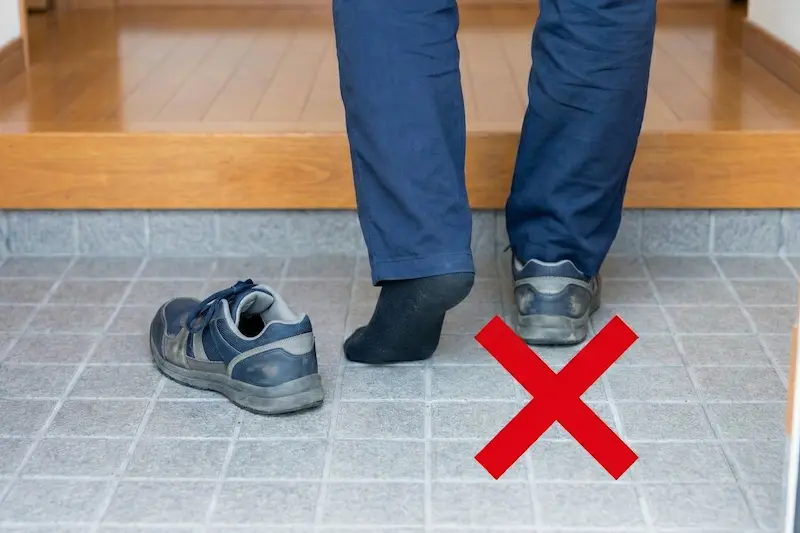
By doing this, your socks will get dirty (Yogoreru / 汚れる) with sand and dust from the Doma.
If you enter the room with those dirty socks, the room will also get dirty.
Once you take off one shoe, immediately lift that foot onto the “floor (Floor / Yuka / 床)” without letting it touch the Doma.
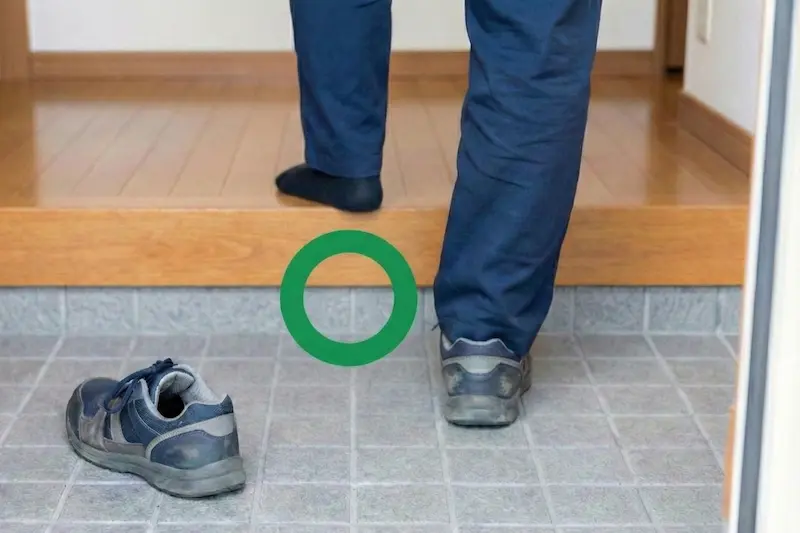
The correct rule is to “step into the house starting with the foot you just took the shoe off from.”
③ Forgetting to say “Thank you” when receiving a uniform
When you join a company, you may be provided with a uniform (Uniform / Seifuku / 制服), safety shoes, a hat, etc.
These are “things the company spent money to prepare for you.”
Do you receive them in silence, thinking it’s “natural” to get them?

“Arigatou gozaimasu. Taisetsu ni tsukaimasu (I will use it carefully / ありがとうございます。大切に使います).”
Just this one sentence will make your seniors feel “I’m glad we hired this person.”
④ Keeping “Hats and Sunglasses” on inside buildings
You might wear a hat (Cap / Boushi / 帽子) or sunglasses for fashion or as protection against sunlight.
However, when entering a company office, dormitory, or a visitor’s building, please be sure to take them off.
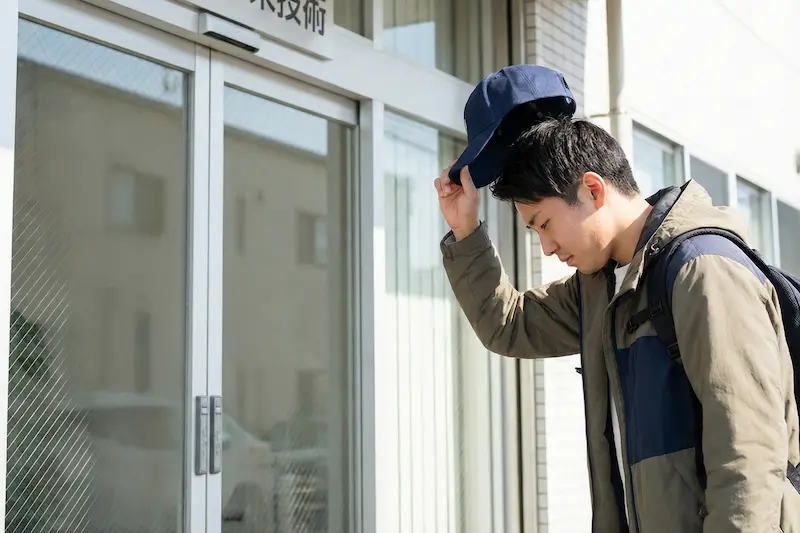
In Japan, “looking into someone’s eyes while talking” and “showing your face” are signs of trust (Trust / Shinrai / 信頼).
Especially if you wear sunglasses when greeting, it gives a slightly scary and rude impression (Rude impression / Shitsurei na inshou / 失礼な印象).
⑤ Using a “Smartphone” or “Leaning against the wall” while waiting
On your first day of assignment, you may be told “Please wait here” while a senior prepares.
What do you do then?
NG Action (NG koudou / NG行動):
- Taking out your smartphone to play games or look at SNS.
- Resting by leaning against the wall (Leaning against the wall / Kabe ni motareru / 壁にもたれる).
- Putting your hands in your pockets.
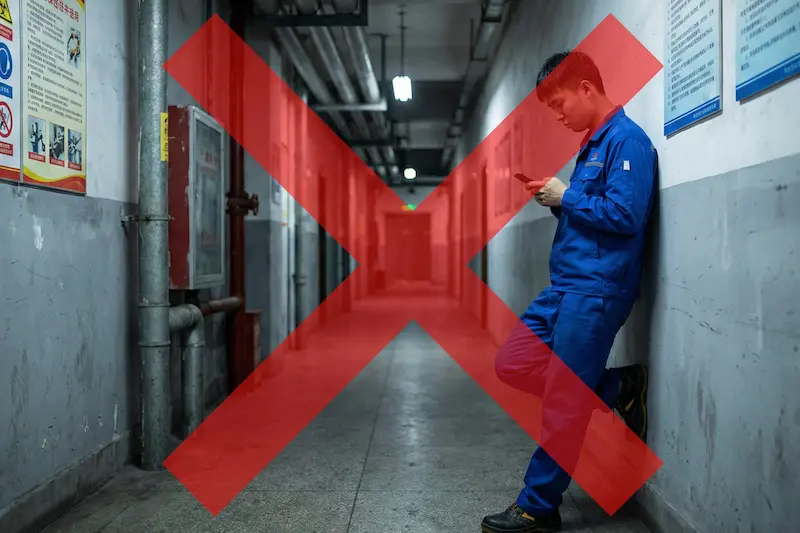
When Japanese people see this, they feel “Do they not have the will to work?”
The time spent waiting is also during work (On duty). Let’s straighten our backs and wait quietly.
⑥ Not taking out a “Memo” when listening to instructions
When a senior is explaining the work, are you just standing and listening?
It’s okay if you can’t understand all the Japanese. Please be sure to take out a “Note and Pen (Note to pen / ノートとペン).”

Just by taking a pose (Pose / ポーズ) of taking notes, the other person will feel relieved, thinking “They are trying hard to remember.”
Conversely, if you don’t write anything down, they will feel anxious, thinking “Did they really remember? Won’t they forget by tomorrow?”
Summary: “Charm” is more important than technology!
It’s okay if you can’t do the work at first.
However, if you have “Manners” and “Charm (Charm / Aigyou / 愛嬌),” your seniors will teach you kindly.
Please follow these 6 points and make a good start to your life in Japan (Life in Japan / Nihon no seikatsu / 日本の生活)!