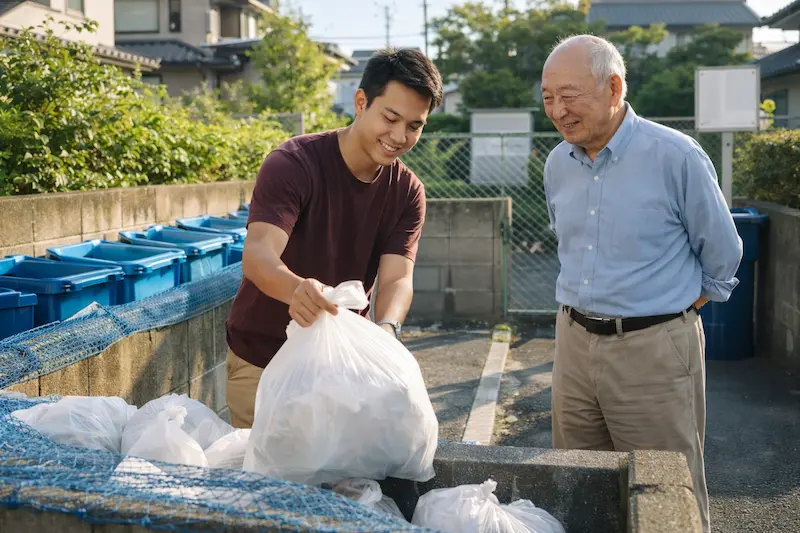
Hi! It’s Sensei.
The first thing that might surprise you when you come to Japan is the “Garbage Disposal Rules (Gomi-dashi / ゴミ出し).”
“Combustible? Plastic? Where do I throw this?” It’s natural to be confused.
But if you don’t follow the rules, neighbors might get angry or you could have trouble with your landlord (Oya-san / 大家さん). Today, I’ll teach you the “4 Promises of Garbage Disposal” for a happy life in Japan.
1. “Sorting (Bunbetsu / 分別)” is the Basic
In Japan, you must sort garbage into detailed categories. Let’s remember these 4 main types.
① Combustible Waste (Moeru Gomi / 燃えるゴミ)
Food scraps, paper, dirty plastics, etc.
② Non-combustible Waste (Moenai Gomi / 燃えないゴミ)
Glass, metal, small home appliances, etc.
③ Recyclable Waste (Shigen Gomi / 資源ゴミ)
PET bottles, cans (kan), glass bottles (bin), cardboard. It’s good manners to wash them before putting them out.
④ Oversized Garbage (Sodai Gomi / 粗大ゴミ)
Large items like furniture or bicycles. It costs money to throw these away.
2. Use the Designated “Garbage Bag (Gomi-bukuro / ゴミ袋)”
In Japan, many cities have their own special garbage bags. You can buy them at supermarkets or convenience stores (Konbini / コンビニ).
Note that if you put garbage in a different bag, they won’t collect (Kaishu / 回収) it. Generally, you should use “transparent” or “semi-transparent” bags where the contents are visible.
3. Disposal “Time” Depends on the Location
The time to take out the garbage is determined by where you live. This is a very important rule.
In most places, it’s common to put it out “on the morning of the day (by around 8:00 AM).”
However, in places like Fukuoka City (Fukuoka-shi / 福岡市), the rule is to “put out garbage at night.”
Be sure to check if your dormitory (Ryo / 寮) rule is “morning” or “night”!
4. If Confused, Ask “Sensei” or “Senpai”
If you’re wondering “What kind of garbage is this?”, don’t just throw it away. Ask a Japanese person at your company, a teacher from the union, or a senior (Senpai / 先輩) who has lived in the area for a long time.
“Asking is not something to be ashamed of.” It’s much harder to deal with trouble after throwing it away incorrectly.
🔍 Let’s Research the Rules for Your City!
Garbage sorting rules are completely different depending on where you live.
Search on Google with your “City Name (Machi no Namae / 街の名前)” and “Gomi Bunbetsu (Garbage Sorting).”
The City Hall (Shiyakusho / 市役所) website often has “Garbage Guides” in English, Vietnamese, Chinese, etc. Be sure to check it out!
Summary: You’re a “Pro” if You Can Handle Garbage
When you can follow garbage rules, neighbors will feel relieved and think, “That person is reliable.”
It’s difficult at first, but let’s learn bit by bit by looking at the calendar!